Showing posts with label diversification. Show all posts

Tuesday, December 30, 2008

Cutting My Tax Bill

In 2002, as the dotcom bubble was going through its painful deflation, I took my first steps into stock investing, and what painful steps those were. After it was already down by about 50%, I bought a sizable stake in the NASDAQ index fund QQQ. I figured: how much more could it fall? Well, it turns out the a lot more. At the bottom, my position was worth a staggering 67% less than my original investment. Worse, we never recovered those losses. At its best point - in October 2007 - more than five years after the original investment, the position was still about 20% under water. After the crash of 2008, that position is now 56% down.

Well, I have decided to make some money on that miserable investment decision. Or at least, I have decided to cut my losses. Last week I sold off enough of that position to take advantage of the $3,000 ordinary income deduction for the 2008 tax year. We typically buy and hold for the long term, but I figure it's time to admit a mistake and at least harvest some of this loss. By the way, I did not remove this money from the market, I used the funds coming out of QQQ to beef up our REIT index fund which has been badly beaten down over the past year. Rebalancing.

There is another lesson hidden in this little fiasco: no matter how much you think the stock market is beaten down, it might surprise you and fall a lot more. This lesson is not lost on me, and the comparison to the current situation may be a good one. My mistake in making the QQQ investment was to place all our eggs into one basket - investing in technology stocks. My other mistake was moving into the market in one lump sum, rather than moving in gradually over time. I have tried to learn from that mistake and we are now broadly diversified. In addition, I am now very careful about moving money into the market gradually, over time, through monthly, fixed contributions. Still, it is possible that six or seven years from now I will be selling positions I am buying today to offset a looming tax bill. Let's hope not.

Enjoyed this post? Please consider subscribing to Money and Such by free RSS Feed or by email.

Monday, May 19, 2008

Reader Question: Should I Get Out of Commodities?

A couple of days ago I received an e-mail question from a good friend and regular reader. Here is the full text of the question:

"Hi Shadox,

A year ago, I put about 20% of my assets into commodity related stocks as a hedge for the blazing US and APAC economy: Metal and mining ETF; Mining companies; Brazil ETF (since their economy is based on commodities); Oil company stock. Since then, most of my portfolio has shrunk while this part has exploded.

It is now about 40% of my portfolio. Now, there is talk about a commodity bubble. I have some free money and I was thinking about putting it into a commodity hedge, but I don't know what that is? Cash? Bonds? Technology? What do I do?

Also, my gut tells me Oil is peaking (my gut told me that at $80 too so I am not sure using my intestinal system is a good idea). What is an Anti-Oil hedge? You could use this for a Blog post since I am sure anyone with commodities in his portfolio is thinking the same things...."

I have been wrestling with the same question in reverse, namely, is it too late to invest in commodities? About two months ago I have come to the (apparently premature) conclusion that hell yeah, it's too late. We are not currently invested in commodities. I recently rolled over my 401K which had a 10% commodities position into an IRA which does not include such a position. However, I do understand the benefit of diversifying into commodities and have written about this in the past (too bad that I did not actually take my own advice at the time).

When I think about diversification into commodities, I am thinking about a position equal to about 10% of your portfolio. However, the reader finds himself with about 40% of his portfolio dedicated to what is potentially a very risky asset class. Let me take the reader's questions one at a time.

First things first: we need to talk about portfolio re-balancing. If you are shrewed, wise or lucky enough to make a small investment whose value explodes, you should probably think about re-balancing your portfolio such that your investments in the various asset classes come back into line with your original plan. There are many reasons to do so, but let me name the most important one: regression to the mean.
Here's the idea - each asset class has certain typical historical returns. If the return on such an asset class in the short run is dramatically higher or lower than the historical average, there is a tendency for prices to return to their historical trend through a price correction (up or down). We are living through one such example right now. In recent years real estate prices have skyrocketed and returns on real-estate assets have significantly outpaced their historical levels. No more. Returns are now regressing to the mean by way of a sharp decline in house values. Tech stocks in the beginning of this decade went through the same process, and I believe that we may be in for a similar ride on the commodities side. If your portfolio is out of whack due to massive returns, take some money off the table to reduce your exposure to that asset class and re-balance your positions.

True, this is psychologically difficult to do because essentially I am suggesting investors should sell their winners rather than their losers... but, believe it or not, that's probably a winning strategy.

Let me address the second part of the question: what is a good hedge for commodity prices? Put in other words, if commodity prices go down, which asset classes would be unaffected or even benefit from this decline? The technical term from what reader is looking for is negatively correlated assets, or at least uncorrelated assets. The following asset classes have historically been negatively correlated with natural resources: U.S. Bonds (-0.14 correlation); cash (-0.12 correlation); high-yield bonds (-0.04 correlation). If you think about it, this makes perfect sense. Commodities tend to rise at times when the economy is strong, inflation is rising and interest rates are consequently being increased. These are exactly the times when bonds tend to do worse, and vice-versa. Stocks, especially large cap stocks, are also very loosely correlated with commodity prices (0.0 for large caps; and 0.01 for the S&P 500). A correlation close to zero indicates that the asset classes tend to act independently from each other: they are just as likely to move in tandem as they are to move in opposite directions. In fact, natural resources are very loosely correlated with pretty much all traditional asset classes. This makes them a very interesting diversifier, but not at 40% of your portfolio...

To read more about asset class correlations, take a look at this excellent article, which I have previously written about.

Tuesday, November 13, 2007

Employee Stock Option Plans - Time to Sell?

I subscribe to "My Personal Finance Journey", an excellent PF blog. Last week mm posted an update of his net worth, which included a dramatic increase in the value of his employee stock options. I have heard this story before...

Back in the rockin' dot com bubble days, my wife worked for a high flying Internet company. She joined at the right time and received some stock options at a strike price of $3. At their highest, each share of the company was worth over $160, and we were close to being millionaires on paper (before taxes). Talk about a major windfall.

Did we sell at the right time? Not exactly... The stock dropped all the way to low double digits, and while we made some money selling on the way down, we were left with only a fraction of the potential gain. We learned a very, very expensive lesson.

So, how do you know when it's time to sell your employee stock options? Here are few ideas:

It's Not Fake Money - many people are much less concerned about losing money on their stock options, than they are about losing their other assets. I can't quite explain this, but it may have something to do with the notion of "easy come, easy go". Truth is, there is absolutely no difference between stock option gains and money that you receive in your pay check. Treat your stock option gains as you would any other income.

Don't Be Afraid - when I urged my wife to sell more of her stock options, she was concerned that we would feel like dummies if the stock continued to appreciate, while we sold at a lower price. I had the exact opposite fear. I was worried that the stock was going to drop, taking our wealth with it. We were both motivated by fear, and both of us were wrong. Even though my proposed course of action would have generated more money for us, I could not have known it at the time, and my reasoning was not the correct one. One should not make investment decisions based on fear. Investment decisions should be based on goals; risk tolerance and diversification. The same logic applies to employee stock options.

Use the Materiality Rule - If your stock options represent a substantial percentage of your net worth, you should diversify your investment and sell at least some of them. For me, the materiality line crosses at about 10% of my net worth. Any less, and I am not likely to be too stressed by the ups and downs of my company's share prices.

Would You Invest More -if you were given an amount equal to your stock option gains and were told to invest these gains in the most productive manner, would you invest them by purchasing options on your company stock? If your answer is negative, it's probably time to sell.

Mitigate the Stress, Sell Over Time - to make the decision easier on yourself, I propose the automatic selling approach. When my wife and I could not agree on whether to sell or hold the stock options, we compromised. We agreed that we would sell a set quantity of options on the first day of each quarter, regardless of the price at which the stock was trading. The quantity we agreed upon would completely eliminate our position in the stock over approximately two years. This strategy of selling gradually allowed us to diversify away from the stock, while ensuring that we did not sell large quantities of stock into a temporary dip in the stock price.

There is also an important counter-argument here. For many of us, stock options are our best and biggest shot at riches. I mean, just yesterday I read a story about the office masseuse at Google retiring after her stock options made her a millionaire. Of course such stories are exceedingly rare, but if you believe that your company's stock could take off and catapult you into the ranks of the independently wealthy, should you really give up on this shot at riches? That's a question each of us has to answer for his or her self. Personally, I am probably too risk averse to hold onto sizable, unrealized stock option gains. How about you?

Sunday, November 04, 2007

Stupid Financial Advice

I was traveling on business this week, in various parts of the country. On Thursday morning, I was having my breakfast at a Holiday Inn Express and casually watching a morning show somewhere in North Carolina, when I heard some extremely stupid financial advice coming from the TV.

The show contained a stock market segment in which the financial correspondent covered the recent run-up in Google stock. She commented that the stock just crossed the $700 mark. The anchor, impressed, asked if there were any plans to split the stock. The financial correspondent explained that Google's philosophy was to encourage serious investing rather than trading, and so had no intentions of splitting the stock. Here is where the stupid part begins. The following is not an exact quote, but it's pretty close:

Anchor: "If you only have a small amount of money to invest, how can you get in on the Google game?"

Financial Correspondent: "as a small investor, you can save your money and buy a single share of Google. Google has been showing such impressive results, that you would be better off buying a single share of its stock than buying more shares in weaker companies".

I am sorry, but if you do not understand the basics of investing, you have no business going on TV as a financial correspondent and misleading small investors.

What's wrong with that exchange? Well, for one thing, it assumes that Google's impressive past performance will continue into the future. Just because a stock, a mutual fund, or even the market as a whole has shown impressive results in the past, there is absolutely no guarantee that it will continue to do so in the future. In fact, assets have a tendency to "regress to the mean". If something has shown a dramatically faster appreciation than the overall market in recent years, it may be due for several years of under performance. That is the reason why investors should re-balance their portfolio by selling some top performers and buying some laggards. What the financial correspondent suggested is known as performance chasing and is a great way to ensure that you get burned financially.

There is another fundamental problem with the financial correspondent's advice. If you only have enough money in your portfolio to buy a single share of Google stock, the resulting one share portfolio is completely undiversified. From that point forward, your portfolio's fate is completely tied to the fate of a single company. This is a very risky proposition, regardless of how strong you believe the company you invested in really is. If you only have a small amount of money to invest, do yourself a favor and buy a diversified index fund instead of a single company stock. Vanguard's Total Market Market Index fund (VTSMX) may well fit your needs.

Thursday, October 25, 2007

Think You're Diversified? Think Again.

Diversification is the mark of a good portfolio. Modern portfolio theory shows that for any given level of risk, the best performing portfolio is a diversified one. You can diversify your portfolio by buying a large number of individual stocks and bonds, but many of us choose a simpler method of diversification - we buy mutual funds.

A potential problem with that approach is that if you own more than a single mutual fund, you may be less diversified than you think. This is because it is possible that your funds are investing in overlapping sectors or even in the same individual stocks. Even though I invest our portfolio exclusively in highly diversified index funds, I recently decided to dig into our portfolio to determine whether we truly are diversified. I did so using e*Trade's recently launched portfolio analyzer tool.

The good news is that we do appear to be well diversified. However, even in our diversified portfolio there were some overlaps between funds. For example, Vanguard's Total Market Index (VTSMX), Vanguard's Growth Index (VIGRX) and the QQQQ ETF all contain a small percentage of Google stock. The result is that our portfolio contains double the amount of Google stock it would if we simply invested in the Total Market Index fund. The same is true for Apple, Cisco, Intel, GE, 3M and so forth. All in all, there is no real problem for our portfolio, since no stock accounts for more than 0.6% of our holdings. Still, you get the idea.

So how can you make sure that you don't over expose yourself to undiversified stock positions by investing in mutual funds? Here are a few rules of thumb:

1. Check Your Portfolio - using a tool such as e*Trade's portfolio analyzer made this process very simple for me, but you can achieve the same result by simply going through your fund prospectuses. If you find substantial overlaps, consider divesting of one or more of your funds.

2. Invest in Indexes - investing in Indexes should reduce the likelihood of dramatic overlaps, since index funds are, by nature, diversified and do not place sizable bets on specific stocks.

3. Avoid Sector Investing - if you concentrate your investments in a specific segment of the market, you are more likely to be investing in multiple funds that hold large, overlapping positions of a particular stock.

4. Don't Double Up - realistically, you only need a single mutual fund to cover each major asset class. Theoretically, you could invest in a total market index fund (e.g. VTSMX), a total bond market index fund (e.g. VBMFX), a total international index fund (e.g. VGTSX), and a real estate index fund (e.g. VGSIX) and your portfolio would be very well diversified. There is no need to select more than one mutual fund that covers a specific segment. The fewer funds you have, the lesser the risk of these funds overlapping and creating an under diversified position.

There is one more complicating factor: most of us have multiple accounts with different financial institutions - brokerage account, IRA, 401K, 529 and so forth. Checking for overlapping stock positions across multiple accounts is somewhat harder, but it is a worthwhile exercise. Even if your positions are well diversified in a specific account, you may have some overlapping, undiversified positions in some of your other accounts. You'll only know if you check.

Saturday, October 13, 2007

The Stock Market is Not That Safe

A few days ago I had a lively discussion with Matthew of Crazy Money about whether it is a wise thing to hold a long term portfolio consisting entirely of stock investments. I argued for a well diversified portfolio comprised of weakly correlated asset classes. Matthew argued that since the stock market provides the highest long term expected returns, the best way to go is a 100% stock based portfolio. I wanted to revisit this issue and add a little more data.

Essentially, the core of Matthew's argument is that over the long term the stock market is safe. If you have 40 years to wait, the stock market will invariably go up. In last week's The Economist, I found an article called To Infinity and Beyond, which addresses this very issue. Let me offer a few choice quotes from the article:

"Among American financial commentators, it is almost universally accepted that shares always rise over the long run. And this perception does seem to be backed up by evidence; if you take any 20-year period, Wall Street has always delivered positive real returns. In addition, one ought to expect shares (which are risky) to deliver a higher return than risk-free assets such as government bonds.

Nevertheless, investors ought also to remember the world's second largest economy, Japan. Its most popular stockmarket average, the Nikkei 225, peaked at 38,915 on the last trading day of the 1980s; this week, nearly 18 years later, it was still only around 17,000, less than half its peak. Buying on the dips did not work either. By 1994, the Nikkei had fallen to 21,000—at which point a technical analyst, after poring over his charts, told this columnist that it had to be one of the great long-term buying opportunities."

And another quote:

Elroy Dimson, Paul Marsh and Mike Staunton of the London Business School examined the record of 16 stockmarkets which were in continuous operation over the course of the 20th century. In itself, this selection showed survivorship bias by excluding the likes of Russia and China. The academics found that only three other countries could match the American record of having no 20-year periods with negative real returns.

Other investors were far less lucky. Japanese, French, German and Spanish investors all suffered instances where they had to wait 50-60 years to earn a positive real return; in Italy and Belgium, the waiting period stretched to 70 years. It was no good following the famous advice to “put the shares in a drawer and forget about them”; the furniture would not have lasted that long"

I still have some QQQQ shares I bought in 2002 which are still about 20% below their nominal purchase value, they are much lower than that if you take inflation into account.

Now, don't get me wrong, most of our portfolio is invested in the stock market. However, I think that this article underscores the need to diversify beyond that asset class, and into assets that would not be impacted - and hopefully would even benefit from a decline in the stock market. Many would argue that the American stock market is unique and that it will not experience the kind of decades long bear market that other markets have seen internationally. They may be right, but is it wise to bet your financial well being on this assumption?

Tuesday, October 09, 2007

Advanced Portfolio Building III

Over the past week I have written a couple of posts on the topic of diversification and asset allocation. Today, I would like to discuss in a bit more detail a specific asset class that I am considering diversifying into: commodities.

For those readers who are not familiar with the concept of commodities, these are essentially the basic goods upon which the modern economy is built. They are typically divided into five categories: Energy, such as oil and natural gas; Industrial metals, such as copper and aluminium; Precious metals, such as gold, silver and platinum; Agricultural commodities, such as corn and wheat; and finally, livestock, such as live cattle.

Why diversify into commodities? The main reason is that, as explained in my previous post, commodities move independently of equity prices, or in more technical terms: the correlation between these two asset classes is close to zero.

While doing my research into the feasibility of commodity investing, I came across this informative article in the Journal of Financial Planning. One of the main points I wanted to research was the expected return of the commodity asset class. According to the article the average annual return of the Goldman Sachs Commodity Index (GSCI) between 1970 and 2006 was 11.5%. That is pretty impressive. Just as importantly, the commodity index seems to generate the highest returns in times of unexpected inflationary pressures. This means that while the rest of your asset classes may be suffering the twin scourges of inflation and high interest rates (which the Fed uses to combat inflation), investments in commodities tend to perform at their highest levels. For a more complete picture of the historical performance of this asset class, take a look at a chart of Dow Jones AIG Commodity Index (DJAIG).

The article offers a quantitative analysis of the diversification benefits offered by commodities. I will save you the suspense. According to the article a portfolio weight of 24% in commodities between 1970 and 2006 resulted in a a higher return compared to a portfolio of 60% stocks and 40% bonds; while simultaneoulsy reducing the volatility of the portfolio by 13.5%. That certainly gives me some food for thought.

Once again, it seems that the main issue is finding a good vehicle for investing in the commodities market. The article mentions two ETFs, GSG and DBC as funds worth considering, but both of these funds seem relatively new and don't offer enough of a track record for my taste.

I will do some more thinking on this topic. I am not quite ready to jump into that particular pool.

Sunday, October 07, 2007

Advanced Portfolio Building II

A couple of days ago I wrote a detailed post I called Advanced Portfolio Building. As of now, that article received only a single comment, but I think that comment merits a detailed discussion and I will do so in this post. Let's begin by reviewing the full text of the comment, left by Matthew from Crazy Money:

"There are two methods for reducing volatility in a portfolio: building a basket of assets with weakly or anti-correlated betas, or increasing your time horizon. No discussion of risk and reward is complete without including the impact of time on both quantities.Given a sufficiently long window, there is no reason to invest in anything but 100% equities. Diversifying beyond this asset class would only create a drag on your final return and increase transaction costs.

I agree with some of the points Matthew is making in his well thought-out comment, but I strongly disagree with others. Clearly, Matthew is right that the longer your time horizon the more aggressive your portfolio can be. This is a basic truth of investing.

However, let's make a distinction between risk and expected return. Risk is traditionally measured by the volatility of the asset class in question. Volatility is the relative change in price over time. The concept of risk is strongly related to but is very different from the concept of expected return. Expected return is the amount of money you would receive, on average, over a certain period of time, by investing in that asset class. Let me give an example that will clarify the difference between those two concepts:

The S&P 500 for example has historically averaged a return of approximately 7.3% per year since its inception (not including dividends). If you believe that the S&P will continue to behave as it previously did, your expected return is about 7.3% per year (plus dividends). However, the S&P very rarely yields exactly 7.3%. The return fluctuates. Some years the S&P returns double digit gains, other years investors lose an arm, a leg and one buttock. The S&P (as well as all other equity) is a relatively volatile and hence risky asset class.

Given the option between a volatile asset and a stable asset, both of which are expected to return the same amount, a rational investor chooses the more stable asset. Why accept uncertainty and risk if in the end you expect to make the same amount of money? Think of it this way: if you were able to get 7.3% on a CD, every year, for the foreseeable future, would you invest in the S&P which on average would yield the same return, but could have some seriously down years included in the mix? Of course you wouldn't.

With the concepts of expected return and volatility safely locked in out heads, let's go back to Matthew's comment. Matthew is saying: "There are two methods for reducing volatility in a portfolio: building a basket of assets with weakly or anti-correlated betas, or increasing your time horizon". That statement is not correct. By increasing your time horizon you are more likely to achieve the expected average return on the asset class in which you are investing (7.3% in the example we used above), but you are doing NOTHING about volatility.

Let me explain: in any given year the stock market may tank or soar, but if you stay in the market for a large number of years, your chances of achieving your expected return are high. Compare it to a game of heads or tails. If you flip a coin twice, you wouldn't be surprised if it came up heads (or tails) twice. However, if you repeated that coin flip 1,000 times you would expect (and the laws of probability are on your side) that the number of heads and tails will be pretty close to each other. You would be really surprised if you threw heads 900 times and tails only 100 times - although that too COULD happen. This is because the expected outcome of the game is that 50% of the time you will flip a head, and 50% tails will appear. However, the long term expected outcome has absolutely no bearing on the next flip of the coin.

Matthew is confusing volatility with expected return. By expanding your time horizon you are likely to achieve the expected return, over the life of your investment, but that does not reduce the risk that your portfolio will tank in any given year.

Enter diversification: going back to the coin flipping game. Diversification is akin to playing heads or tails with several coins simultaneously. Each coin represents a different asset class in your portfolio. The chances of flipping all tails when using, say, 10 coins simultaneously is vanishingly small. Diversification reduces the volatility of your portfolio, and in many cases it can do so without reducing your expected return. Matthew's statement that "Diversifying beyond this asset class [equity - Shadox] would only create a drag on your final return and increase transaction costs", is simply not accurate. More about this specific point in a future post.

In the meantime, I will let this excellent example from The Sun's Financial Diary, speak for the merits of diversification. I suspect that if diversification beyond equities was not a worthwhile undertaking, a sophisticated investment team such as Yale's endowment managers wouldn't bother with it... 'nuff said.

Thursday, October 04, 2007

Advanced Portfolio Building

Warning: the information in this post is about how to achieve more effective diversification in your portfolio. It may actually be useful, but it might not be an easy read.

Diversification is a very useful trick. It allows you to maximize your return for a given level of risk, or to minimize your exposure to risk at any target level of return. Diversification works because different assets do not always move in lock-step, such that a decline in the price of one asset is often offset by an increase in the price of another asset.

Diversification becomes more effective as the correlation between your different asset classes declines. In other words, if you want to increase your level of diversification, your portfolio needs to include asset classes that have a more tenuous link with each other, or better yet, assets that are negatively correlated. For those readers who are less statistically inclined, if two assets are negatively correlated they tend to move in opposite directions.

Although our portfolio is well diversified by most measures, I noticed that during much of the market turmoil we experienced in July, most of our asset classes moved in the same direction: down. Domestic and international stocks, bonds and real estate all seemed to face the same price pressures. This prompted me to do some research, and led me to discover this phenomenal article, in the July issue of the Journal of Financial Planning. The article offers detailed correlation matrices between 17 different asset classes.

According to the article, the asset classes that exhibit the lowest average correlation with the S&P 500 are: U.S. Bonds (0.23); Global Bonds (-0.03); Cash (0.02); Natural Resources (0.01); and Long - Short investments (-0.01). Let me interpret these results for you: on average, if the S&P moves up by 1% on a given day, the average cash position will tend to move 0.02% in the same direction, while a diversified global bond position would tend to move 0.03% in the opposite direction.

Bonds truly are an excellent way to diversify a stock position. Global bonds are an even better way to achieve this goal. How many of us have global bonds in our portfolio? Not very many.

How do real estate (as measured by REITs) and International stocks fare in the diversification department? Good, but not great. International stocks have an average correlation of 0.55 with the S&P, while REITs have an average correlation of 0.52. In addition, at certain times these asset classes exhibit a substantially higher correlation with the U.S. equity market. So, while these asset classes offer substantial diversification, this benefit sometimes diminishes to a large extent.

Without boring you with the details of the statistical analysis offered in the article, you should note that the correlation values provided above are averages and that the correlations of some asset classes vary dramatically over the years. However, the article mentions natural resources, long-short, U.S. bonds, global bonds and cash as the five asset classes that consistently offer the best diversification benefits with an equity position. It is also interesting to note that the same asset classes also have a weak correlation with each other.

I highly recommend taking the time to read the full article for yourself.

More about this article and its take aways in the coming days.

Thursday, September 20, 2007

Finances in Your 20's

A few days ago an anonymous reader left a detailed comment regarding the "Finances in Your 20's" series of posts I did a couple of months ago. I thought it would be interesting to post the full text of the comment and share my thoughts about it.

Here is the comment in full. I added emphasis in a number of places:

"Thanks for the great series. I read it very carefully as I AM in my 20's, fell into a GREAT job, and realize there is great financial potential if I make the right choices now. Everyone says "start young" or "don't make mistakes when you're young" or "I wish I would have... when I was young." But not very many people offer practical advice of what to do WHILE you're young, have a great paying job, and need to know what to do with all that disposable cash.A few

Points of reaction:

1. House. I bought one. The housing market where I live was far too tempting not to, I couldn't stand living with family a second longer, and I wasn't about to throw away thousands in rent. I think if you're planning on staying with your current job for at least 5 years, and you are in a strong growth area, you can't do any harm purchasing a house. It also helps TREMENDOUSLY at tax time, since I have no dependents to claim on my return.

2. Savings: I currently contribute 6% to the company 401k and my company kicks in an extra 4% (yay for free money), but having non-taxable savings seems VERY attractive. I will definitely look into the ROTH IRA. I hadn't considered IRAs, since I have pretty much maxed my current paycheck out.

3. Stock: I have several thousand shares of options in my company, and have just started participating in the company stock purchase program which allows me to purchase stock every 6 months at 85% of the lowest market value. I am maxed out at 10% of my gross in that program.

4. Charitable donations. This is one you didn't mention that I think you should have. Young people, no matter how poor, should get in the habit of giving back. I give between 10-12% to my church and other charitable organizations. It helps at tax time and it's the right thing to do. If you wait to be "rich enough" give back, you will wait forever.

I wish I could do more... like start a ROTH, or diversify my portfolio, but I'm pretty maxed out. I had to give up my glamorous vacations to start doing the stock purchase program. Now I just go home for the holidays. I have to constantly evaluate my life/money balance, and certain things like gym memberships and cable TV have all met the chopping block.

Also, I really liked your post about investing in yourself/career; spending the extra time and effort while you don't have attachments. I spend my evenings doing work on my own start up company, and while it gets tiring, I'm hoping it will all pay off in financial independence in the future.Any ideas, feedback, suggestions are welcome... "

First of all, what an awesome comment to receive. I really enjoy writing this blog, and it's nice to know that my readers find my articles useful. Thank you very much for taking the time to write such a detailed comment.

Let me comment on some of the points the reader made:

My anonymous reader is clearly well on his way to financial security. He seems to have made many smart decisions, and he understands the trade off between spending and saving. He has taken those first steps to financial stability a decade or more before most of his contemporaries will start to think about issues of financial planning. Kudos!

Regarding the purchase of a house while you are in your 20's. I have written a number of posts about why I don't think that real estate is a good investment, and particularly why I don't think it is a good investment for people in their 20's. However, if you are buying your house because you want to move out and own your own place - and not as an investment - there is absolutely nothing wrong with it. I completely understand that some people really need the emotional attachment, convenience and perceived security of owning a home. However, I always find it strange when people refer to renting as throwing away money. I have many points to make on this topic and will address them in a future post. For now, I will share only one important thought: by renting I am able to take the large chunk of cash that would otherwise be tied in bricks, and invest it in highly diversified, high yielding investments. I am not throwing away money on rent, what I am doing is the equivalent of taking out a low cost loan to invest in a highly profitable opportunity. Somebody else's capital is tied up in the house I live in.

One a different note, there are two financial errors I think that the commenter is making. The first is owning a large number of shares in his own company stock. To find out why I think this is a big error, see my post on the subject. I also think that the reason the commenter is accumulating shares is his company's ESPP which allows him to purchase shares at a discount. Purchasing the shares is the right move. Hanging on to them is not. Once the shares are purchased at a discount, it is probably a good idea to sell them and pocket the difference. More about my proposed ESPP strategy in this post.

Although the commenter does not say so explicitly, I am getting the sense that he thinks he is not diversified. If that is the case, this is a serious financial error. To diversify your portfolio you don't need to have a lot of money, and you don't need to to pay through the nose to achieve diversification. Here is a good way to take a step in the right direction: when you sell your company shares, use the proceeds to purchase a diversified index fund, such as Vanguard's Total Market Index Fund. Diversification is a sound financial strategy that will pay off in the long run.

The reader is clearly doing almost everything right financially, but he appears to be paying a high personal cost for some of his decisions. For example he mentions that he is no longer taking "fancy vacations". To me it's all a question of happiness. I used my 20's to travel the world. Yes, it cost a lot of money, but I don't regret that expense for a second. Let me tell you something: as a mid-career professional, taking large chunks of time off to go traveling is not very feasible. Doing it with three small kids is pretty much impossible. So, yes, plan for your financial future but make sure you don't fixate on the money. Enjoy your youth. Your memories will last a lifetime and the money is very well spent.

Regarding the after hours start-up and giving back to the community, all I can say is "more power to you!"

As you can see, I read every comment left on my blog, and respond to pretty much all of them. So, keep 'em coming. Let me know what you think about my posts and let me know if there are any topics you would like me to tackle. I will be glad to do so.

Sunday, July 15, 2007

Asset Classes, Diversification & Costs

This is going to be a slightly dis-jointed post. I have several brief and unconnected ideas that I would like to talk about:

Investment Costs - reviewing my parents' investment portfolio this weekend, I was shocked to find that they are paying about 3% in fees to invest in an international stock fund. This is a fund that was recommended to them by a financial advisor.

Academics typically estimate the equity premium at about 6% per year. The equity premium is the extra return that investors receive for investing in stocks rather than in a risk free asset such as t-bills. This means that if t-bills yield 5%, an average stock investment is expected to yield about 11% per year. This increased return is your payment for accepting risk. My parents are paying about half of their equity premium to the mutual fund company. Why on earth would anyone want to do this?

Diversification - it recently struck me that the real-estate portion of our portfolio is not sufficiently diversified. Our real-estate position, which totals approximately 8% of our portfolio, is invested exclusively in Vanguard's REIT Index fund (NASDAQ: VGSIX). This gives us a diversified exposure to the U.S. real estate market, but does not give us any exposure to international real-estate markets.

In recent decades, equity markets around the world have become much more tightly correlated. This means that the diversification benefit gained by investing abroad has declined (it is still well worth it, though). Global real estate markets on the other are far less correlated, which means that they can probably add substantial diversification benefits to our portfolio.

Since my long term objective is to invest 10% of our portfolio in real-estate, I am thinking about increasing our current real-estate exposure by investing only in global real estate markets. If you have any ideas about highly diversified global real-estate funds, please let me know. In my initial research I did not find any global real-estate index funds, so going active may be my only alternative.

Success with My Brother - a few months ago I wrote a post about the fact that my brother was investing his money without a plan and without really understanding what he was doing. In the last few months my brother has gone through an amazing transformation. For one thing, he read a "A Random Walk Down Wall Street" which I had recommended to him, and was fully converted by the experience. Last semester he also took a class in modern portfolio theory, and I am guessing that this was another major factor in this welcome change. Rejoice ye index faithful! We have another convert to fill our ranks!
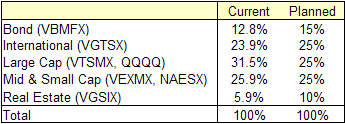
Now the challenge is to convert my parents. The main problem is the fact that my mother's tolerance for risk is much lower than her appetite for returns. This typically causes her to cash out of the market at exactly the wrong time.

I think I may cover that topic in more detail in tomorrow's post.

Monday, June 18, 2007

Asset Allocation in Your 20's

This is the first post in a new series titled Personal Finance in Your 20's that will be running throughout this week. The second post in the series will be published tomorrow and will cover the subject of insurance in your 20's.

When deciding how to invest your money in your 20's there are two main factors that you should carefully consider. Those two factors are: (i) your investment time horizon; and (ii) your tolerance for risk.

Let's talk about investment time horizon first. The amount of time for which you are investing your money will make a very big difference for the type of investment you should choose. For example, if you are saving up for a big vacation next summer, invest your money in safer, less volatile assets such as a CD or a high yield money market account. On the other hand, if you are saving for retirement, and have a time horizon of 40 years or more, you probably want to invest your assets much more aggressively. As a rule of thumb, the more time you have before you will need to withdraw your money, the more investment risk you should be willing to accept.

With respect to your tolerance for risk, only choose investments with which you are comfortable. If you can't sleep at night for fear you might lose your money, that investment is probably not for you. If you are not sure what your risk tolerance is, start by taking one of the many investor profile tests you can find online, to help you answer that question. This is one example of such a test.

For the rest of this post, let's assume that you are in your mid 20's and that you are saving for retirement. First of all, if that's the case, congratulate yourself. You are well on your way to financial security. Now, let's get serious. With 40 years of investing ahead of you, you can afford to invest aggressively and take some risks. I am now in my mid thirties, and my asset allocation currently looks like this. With your time horizon even longer than mine, you can afford to be even more aggressive.

If I were in my twenties and starting a portfolio, I would allocate my funds as follows:

25% large cap stocks
25% small and mid cap stocks
30% international stocks
10% real-estate
10% diversified bonds

In each case, I would choose a highly diversified index fund with low expense ratios (take a look at Vanguard which specializes in such funds). The impact of expenses on your portfolio over 40 years of investing is profound, and one way that will practically guarantee better returns on your investment is minimizing investment costs. With respect to the funds themselves, I would choose the same funds in which I am currently invested. In any case, be sure to keep your portfolio sufficiently diversified.

Finally, you may be interested to know how other people in their 20's are saving for their retirement. This document from EBRI provides a great deal of additional detail. However, in terms of asset allocation, the average 401(k) investor in his twenties has a portfolio that looks like this:

Equity Funds: 51.9%
Company Stock: 10.4%
Balanced Funds: 15.5%
Fixed Income Securities: 20.2%
The remaining 2% are not accounted for in the document.

So, how did I invest in my 20's? The sad answer is that I kept my money in "safe" CDs and money markets, thus missing the big bull market of the 90's. My tolerance for risk was way too low. You could say that I used to have a fear of investing. I got over my fear of investing just in time for the big DotCom bust... yeah, it was fun. BUT, whatever doesn't kill you makes you stronger. I now have a very good sense of my investment goals, and am comfortable with the risk profile of our portfolio.

For more information about some of the topics covered here, take a look at the following posts:

Diversifying into International Markets
How People in their 20's Invest for Retirement

Tuesday, June 12, 2007

Asset Allocation for June 2007

This weekend I spent some time tweaking our portfolio a little bit, to factor in money rolled-over from my wife's old 401(k) to her IRA (see this previous post for several reasons to roll-over an old 401(k) fund).

Here is our currect asset allocation:

Photo Sharing and Video Hosting at Photobucket

After the re-balancing, we are pretty close to our target allocation for the near term. Note that we are currently below our target exposure to the real estate market. We establish our exposure to this asset class through Vanguard's Total REIT Index fund (VGSIX). Our REIT investments have seen several years of double digit price appreciation and I think they are probably due for a substantial correction. In addition, I am still not comfortable that the real estate market has returned to sanity, so while I did not sell any of our current VGSIX holdings, I did not put any more money into that fund. In the longer term, probably within the next 24 months, it is my intention to raise our exposure to the real estate market segment to approximately 10% of our portfolio.

I am also considering creating a direct exposure of approximately 5% of the portfolio to a basket of diversified commodities (including precious metals, oil & gas, and agricultural commodities). I will only do so if I come to the conclusion that this will create some diversification benefit, i.e. I need to understand if and how commodity prices are correlated with the value of some of our other asset classes. If I decide to pursue this investment option it will be as a long term risk reduction strategy, not as a speculative move.

Any insights on the subject will be appreciated.

Tuesday, June 05, 2007

Investing in Emerging Markets

A good friend recently told me that he has decided to place a substantial portion of his portfolio in index funds that specialize in the Chinese market, as well as two other funds that specialize in other emerging markets. When I pointed out that the Chinese stock market has seen dramatic returns recently and that there is serious talk of a bubble (see this excellent post by 1st Million), my friend pointed out that in previous discussions I said that timing the market is a bad idea. He got me there. I did say it, and I believe it.

So how do I reconcile my position against market timing with my belief that my friend's investment carries a substantial amount of unnecessary risk? Well, I don't think that there is really a conflict. In opinion, market timing is not a viable strategy. You shouldn't sit on the fence and wait for a crash before you invest, because you never really know whether a crash is coming. However, taking a sudden and large position in a market that has seen outsized returns for years is probably not advisable either. Regardless of what you tell yourself, such a move probably contains some element of performance chasing. Ask yourself, would I really make the same move if the market lost 20% in the past year?

I guess I should re-state my concern about my friend's investment strategy: it's not that I have a problem with emerging market investments at this specific point in time for fear of a bubble (although the market looks overly ebullient to me). Rather, I am concerned about the speed and magnitude of the move. If my friend took a gradual, dollar-cost-averaging approach to entering this risky investment, I would consider it a much better strategy.

So here is my personal opinion on investing in emerging markets:

1. Investing in emerging markets is a good thing, when done as a part of a broader, adequately diversified investment strategy. Emerging markets have a large potential for growth over the long run, and over such periods their stock markets are also likely to do well. In fact, I would bet that over the really long run, say 20 to 30 years, most emerging market equity markets will outperform U.S. equity markets.

2. Investing in emerging markets is extremely risky. If you are going to invest in emerging markets, make sure that you have the stomach to hold on to your investments even if you lose 50% or more in a single year. Remember the crises in Russia, Thailand and Argentina in the late 90's? Will you be able to hold onto your investments through declines of that magnitude? If you can't weather the down markets, find a less risky investment.

3. Investing in emerging markets is a long term proposition. If you plan to withdraw and spend your money in only a few years, this type of investment is not for you. If your investment horizon is not sufficient and you happen to be hit by one of the massive bear markets that emerging markets are notorious for, you might not be able to recover your losses.

4. Because of the risk profile I outlined above, move into the market slowly. There is nothing nastier than putting a large chunk of change in the market only to see much of it go up in smoke within a few days. If you want to get into the market, set a target time line of a year or so to complete your move, and complete it over a number of trades spaced a few months apart. That will give you some protection against sudden downwards shifts in the market.

Monday, June 04, 2007

Protecting Your Portfolio From a Falling Dollar

The Dollar has been declining against some major currencies for some time. The reasons for this are many, and I certainly don't pretend to understand all of them, however the causes include the U.S. trade deficit; the federal budget deficit; and the expectation that the Fed will begin lowering interest rates soon vs. rising interest rates elsewhere in the world.

Since your income and spending are both in U.S. Dollars, should you care about a falling Dollar? Absolutely. For one thing, while you pay for your purchases in Dollars, much of what you buy is produced abroad and is imported to this country. With a falling Dollar, the price of those imports will increase and you will pay more at the store. For another, if you travel abroad like I recently did, you will immediately notice that things are more expensive since your Dollars buy less local currency. However, the thing that I am most vigilant about is the impact of a falling Dollar on our investment portfolio.

It is no secret that investors from around the world put their money into U.S. securities and assets. Stocks, bonds, and real estate all depend to some extent on foreign money. If the Dollar continues to fall, foreign investors will see their U.S. investments decline when denominated in their own currencies. If they no longer get the returns that they expect, these investors could flee the market, and in so doing cause asset prices to decline. On the flip side, companies that are publicly traded in the U.S. and that derive a substantial portion of their income abroad, are actually likely to benefit from a decline in the Dollar. Goods and services exported from the U.S. will appear to be cheaper to foreign buyers who will be paying for them in their own local currencies. Hence, U.S. exporters are likely to sell more and earn more, possibly causing their stock prices to appreciate.

So, what am I doing to protect us from a further decline in the value of the Dollar. In a word: nothing. I already did everything that I think needs to be done and I am sticking to my strategy. This strategy is a simple one: (i) diversify internationally; (ii) diversify locally. Currently, close to 25% of our portfolio is invested in highly diversified international index funds. I believe that a decline in the Dollar is a net positive for these assets. A highly diversified portfolio of U.S. companies is also some hedge against a falling Dollar, since many of those companies derive a substantial portion of their revenue from exports, and a falling Dollar will improve the fortunes of exporting companies.

I must admit that our bond portfolio is not internationally diversified, however, bonds only account for 12% of our portfolio so the impact of diversification is unlikely to be a be a dramatic one, especially in relatively stable assets as bonds.

Finally, if you are planning a sizable purchase in foreign currency, you may want to consider hedging yourself against exchange rate fluctuations by buying the currency in which your obligation is denominated. For example, if you are planning a big trip to Europe this summer, it might not be a bad idea to buy your Euros right now.

Tuesday, May 15, 2007

New 401K - New Allocation

As regular readers of this blog know, my wife recently started a new position in a Bay Area tech company. Yesterday it was time to sign up for the new 401K plan. Options, options, options.

My wife's new 401k plan is actually not bad. It offers both a traditional 401k plan and a ROTH 401k option. We chose the traditional option, for a variety of reasons which I will go into at another time.

The plan offers about 15 fund options including, surprisingly, two index options: an S&P index fund and a midcap index fund. The plan even offers a real estate fund, and several international fund options - unfortunately, no index options are available for those two sectors. The only two bond fund options offered as part of the 401k have ridiculously high expense ratios of around 0.85%. To which I can only say: are you kidding me?! For a bond fund? In addition, over the past 12 months, both bond fund offerings substantially under-performed Vangaurd's bond index fund (VBMFX) in which we invest seperately. More cost for lower performance. Don't you just love actively managed funds?

Here is the asset allocation we selected:

Schwab S&P 500 Index: 30%
Dreyfus Mid-Cap Index: 35%
Harbor International Institutional: 25%
Cohen & Steers Realty Shares: 10%

You may notice that this is a fairly aggressive allocation, however I would like to point out a number of facts:

1. We manage our entire portfolio as a single unit, not attempting to optimize each individual account seperately.

2. The portfolio we selected, while aggressive, is well diversified with a sizeable international component, as well as a real estate component that has a lower correlation with the overall market.

3. Since we are both in our mid-thirties, our time horizon for retirement savings is a long one. We can afford to ride out eventual bear markets, and wait for the long term performance advantage of the stock market to kick-in. So, for now our retirment investments are mostly in highly diversified stock funds.

Thursday, May 03, 2007

Investing without Goals

Earlier this week I had a conversation with my younger brother about his personal finances. I was very pleased to learn that my brother is saving and investing his money - no debt for him. On the flip side, I also learned that he is making his investment decisions without a coherent investment strategy and without defining fixed goals for his portfolio.

Smart investing starts with setting clearly defined goals. The goals that you set, together with your tolerance for risk, largely determine your optimal investment strategy. My brother, who is in his mid-twenties, could not tell me what he is saving for or define the time horizon for his investments. He is unclear on the concept of risk vs. return, and is largely investing based on the annual results published by the various mutual funds, without consideration for asset classes, diversification or investment cost.

Since he is unclear as to the time horizon for his investments, and is invested largely in volatile stock funds, my opinion is that he is accepting more risk than is appropriate for his situation. Given his age and personal status, most of his personal goals are likely to be shorter term goals (under 5 years). Investing all your money in the stock market with such a limited time horizon is a risky proposition. If I were in his shoes, I would place no more than 50% of my assets in the stock market and put the rest in a combination of bonds and high-yield money market funds.

I also think that my brother is over estimating his appetite for risk, having never gone through a real bear market. He marvels at the fact that his investments have yielded about 10% year-to-date, but like many other investors I don't think that he grasps the connection between high-yields and high-risk. The fact that an asset yields high returns is typically an indication of the higher level of risks associated with that asset. The higher return is the payment investors receive for being willing to accept that added level of risk. I think that this is a topic worth a post on its own, and will take up the challenge in the coming weeks.

My brother is already saving for his retirement (there might be some sense in him after all!). Appropriately, his retirement assets are all investing in the stock market. However, he is not yet a convert to the Index Fund cause, still opting for actively managed funds. I am trying to get him to read my recent post titled Beating the Market of Faking It, and hopefully with time I will be able to help him to see the light.

Over all, I am positively surprised. My brother is debt free and is thinking about personal finance. Yesterday he even went to a personal finance seminar. Now I only need to teach him not to buy swamps and bridges, and he'll be fine.

Friday, April 13, 2007

Employee Stock Purchase Plans: Free Money, No Risk

Yesterday I wrote a post about the pros and cons of investing in your own company stock. My conclusion is that investing in your company stock is a serious financial mistake. However, this rule has at least one major exception: employee stock purchase plans (ESPP).

Many publicly traded companies offer their employees the chance to purchase company stock at a discount. The program typically requires that employees designate a percentage of their after-tax income, which is automatically deducted from their pay check. The money accumulates for a certain period of time, at the end of which it is used to purchase company stock.

Under the terms of my wife's ESPP (at her old company), an offering period would start and end twice a year: Feb 1 and Aug 1. The 15% discount would apply to either the price of the stock at the begining of the offering period or the end of the offering period, whichever was lower. For example, if the price on Feb 1, 2006 was $10 and the price at the actual purchase date on Aug 1, 2006 was $12, you would pay $8.5 per share: 15% below the Feb 1 price. You are guaranteed a 15% return on your money, you have absolutely no risk, and your upside is unlimited. What is there not to love about this program?

Readers who have read yesterday's post understand that I am very much against investing in your own company stock, and true to form the strategy we used with my wife's ESPP was to sell the stocks immediately upon purchase, take our minimum 15% gain and use the money to buy index funds.

Of course, to calculate your real profit you need to take into consideration the opportunity cost of having the cash locked up in the ESPP for three months on average, and factor in the short term capital gains tax which you have to pay on the profit from selling the shares. Even when these are taken into account there is still a large amount of free money involved. If anyone asks, I'll be glad to share the calculation in a comment to this post.

Another benefit of our ESPP strategy is that it is a forced, regular savings plan. The money is deducted directly from your salary, and if you start the program as soon as you join the company, the money never appears on your pay check, so you do not miss it. That money adds up pretty quickly, and twice a year you get a very nice, tidy sum deposited directly into your brokerage account.

In summary, if your company offers an ESPP that includes a discounted stock price, take advantage of it. My advice, however, is to not be tempted to hold on to the stock once it is purchased in the hope that it will appreciate further. Sure, the stock may go up. It can just as easily go down. Sell your discounted stock as soon as you can and use if for a more diversified investment.

Sunday, March 25, 2007

How Risky is Your Portfolio?

A well diversified portfolio is critical to the long term health of your investments. But how do you know if your portfolio is sufficiently well diversified? While organizing my browser bookmarks this morning I came across an excellent website that helps you do just that: RiskGrades.

To use this website you need to register, but registration is free and takes about three minutes. After you register, enter your portfolio, including ticker symbols and number of shares for your various investments, hit analyze and get ready for some very interesting information.

The website gives your protfolio a risk grade between 0 and 1000, where 100 is equal to a well diversified index of global equities, but that's just the begining. It also tells you how your portfolio benchmarks vs. the S&P in terms of risk, and shows you how diversification reduces your overall risk. Next, click on the risk vs. return chart icon (small graphic icons at the top of the risk chart) to find out if your portfolio is generating enough return to justify your current level of risk. Click on the other chart icons to find out your exposure to various asset classes; to generate charts comparing your risk levels to those of other users and much more. This is a really fascinating site that you can spend a good hour on.

So, how did the Shadox portfolio rank? The risk grade I was assigned was 62 - a well balanced investment strategy according to the site. RiskGrades also tells me that our portfolio is 95% as volatile as the S&P and that diversification reduced our risk grade by 7 points. In terms of risk vs. return, every single one of our investments generated at least adequate returns for the level of risk it generates. All in all, I interpert the results to mean that our portfolio is doing exactly what it should be doing. A big HUZZZAAAHHH!

Check out this site and tell me what RiskGrades is saying about your own portfolio.

Also, if you found this post interesting, you might also be interested in the following previous posts: Are You Diversified Enough; Asset Allocation for March 2007; and Diversifying Into International Markets.

Sunday, March 18, 2007

Return of the Bond Investment?

Don't look now, but it looks like bonds are finally begining to generate some reasonable returns. An index investor such that I am, I hold the bond portion of my portfolio in Vanguard's Total Bond Market Index (NASDAQ: VBMFX).

The sad news is that over the past few years, with interest rates on the upswing, returns on this investment have been dismal. To be more specific, the average annualized returns before taxes on distributions was 3.47% over the past 3 years. The technical term: URGGHHH, comes to mind.

It looks like there may be some light at the end of this tunnel. In the past year, the fund has returned 5.93%, which is still below its 10 year average annual return, but is at least respectable. Much of this increase in returns has happened in the past two months (1.42% year to date), and with people now talking about the Fed cutting interest rates, are bonds getting ready to stage a big rally?

Who knows? Quite frankly, who cares? I am an index investor that follows a strict asset allocation straetgy. I am not buying, selling or timing the market. So why am I talking about this? Well, while I don't trade, it's still fun to think about these things and to observe the market. While I control my urge to trade, controlling my urge to talk is somewhat more difficult.