Wednesday, August 22, 2007

Asset Allocation - August 2007

It has been about two months since I last wrote about our asset allocation, so I figure it's time for another update. As you can imagine the past two months have not been too kind to our portfolio. During this period, we have seen our investment portfolio decline by over 6%, this compared to a decline of 3.4% in the Dow, 4.9% in the S&P and 2.6% in the NASDAQ over the same period (June 22 - Aug 21).

Contributing to the sharp decline of our portfolio were our international and real-estate holdings. Vanguard's Total International Index has declined over 11% from its peak earlier this year, while Vanguard's Total REIT Index has declined over 20% from its peak, putting them firmly in correction territory and bear territory, respectively.

Here is our asset allocation as of August 21: Photo Sharing and Video Hosting at Photobucket
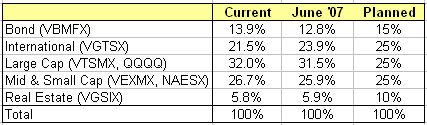
The past couple of months have not been a fun time to be in the stock market, but they have also not been that terrible for long term investors such as myself. Generally speaking, I am happy with our current portfolio strategy and feel that it is working well. For example, during the rough periods, our small bond position has been able to slightly dampen the volatility of our portfolio, as it was intended to do. In addition, while it is true that our real estate and international investments have taken a big hit recently, these sectors have also dramatically outperformed the U.S. stock market in recent years, so we have nothing to complain about. Essentially, our diversification strategy is performing as expected.

We will wait a little bit longer before jumping into the market with more money. When we do, we will increase our positions in both the real estate and the international asset classes to bring them more in-line with our long term asset allocation plan. As I previously mentioned, I try to re-balance our asset allocation by buying more of asset classes that have been under-performing, rather than by selling asset classes that have seen larger returns. This allows me to maintain the needed allocation, without triggering any tax consequences. You can read more about this strategy in one of my previous posts.

Tuesday, August 21, 2007

New Recommended Articles

The Simple Dollar is hosting this week's Carnival of Personal Finance. My article titled How to (NOT) Ask for a Raise, is somewhere in that mix. Once again, the articles that I selected below are those I consider the most original ones:

My favorite article in this week's Carnival is the one offered by Money and Values, covering the issue of mutual fund proxy voting records. As large shareholders mutual funds can have a big impact on corporate policy, but how do they actually vote on shareholder resolutions? Check out the article.

FiveCentNickel has a short and sweet post about how it's OK to Spend Money. Us PF blogger types sometimes forget that money is for spending. Yes, you need to spend prudently and make sure you save for what you really need, but when you come right down to it, denying yourself all pleasure just for the sake of hoarding cash is no way to live your life. The answer, as always, has everything to do with moderation.

Gather Little by Little offers a post about how to make your money greener, that is more environmentally friendly. I am afraid I can't claim to follow any of the advice in the article. Time for some re-thinking?

Finally, Art Dinkin offers his take on the question of whether one should roll-over his retirement savings when leaving his employer. My take on the issue is: absolutely. Here are 6 reasons to roll-over your 401K.

My article regarding the new robot I purchased for frequent flyer miles was included in this week's Carnival of Money Stories. Another interesting article that was included in the carnival was offered by My Wealth Builder and discusses signs that indicate that you are being considered for a promotion. Also note the Carnival of Debt Management which was published this week by Debt Consolidation Lowdown

Monday, August 20, 2007

Didn't Get a Raise, Now What?

In the past couple of weeks I wrote two posts about asking for a raise. The first dealt with ways to ask for another raise, when your raise does not meet your expectations. The second dealt with all the wrong ways to ask for a raise. Today I would like to feature the third post in this series: what to do when your request for a raise is rejected out-right.

There are few things more disappointing or discouraging from a professional perspective than asking for a raise and getting a "No" for your troubles. How do you take that "No" and move forward?

1. Don't Lash Out - the worst thing you can possibly do is react to a "no" by lashing out at your boss or acting out. You are always being evaluated, and your reaction to the bad news is one of those times. Express your disappointment in no uncertain terms, but do it in a dignified and professional manner.

2. Seek Feedback - your best chance of reversing the decision is to understand why it was made in the first place. Is your company having budgetary issues? Are your superiors unhappy with your performance? Did you not achieve certain goals you were expected to attain? The first step to getting what you need, is to understand why you did not get it to begin with. Negative feedback can be a bitch to take, but it is probably the most important type of feedback you can get. Once you know the reason you did not receive the raise, you can plan your next moves.

3. Build a Plan - After you understand the reason you were turned down, you can move to the next step. Act on the information you gained and build a plan to reverse the decision. Speak with your boss candidly and offer a specific set of actions you will take to improve your performance and attain the goals you need to meet. Make sure you include a deadline by which you will meet each of the goals. When you speak with your boss, try to get him or her to commit to supporting your request for a raise if you achieve the targets you laid-out. After you speak with your boss, put your plan in writing and send it to him or her via e-mail. It is amazing how much written documents get taken more seriously than mere conversations.

4. Find a New Place in the Company - it is possible that your current position in the company will not allow you to advance your career or receive the raise you want. If you truly feel that this is the case, and if your organization is large enough to allow such a move, look for a new position within the company. Sometimes all it takes is a new boss or a new set of responsibilities to allow you to take that next step.

5. Find a New Job - moving to a new job is always a risky proposition. For one thing, nothing guarantees that your new company will work out any better than your last one. However, sometimes the only way you will get your dues is by making a move.

Saturday, August 18, 2007

American Express Security

My American Express Blue card is about to expire at the end of the month. This is my favorite card and I use it for practically everything (wherever they accept American Express), since it offers the best cash back rewards of the three cards that we hold.

Yesterday my wife received her new card in the mail, and since I did not receive mine I called American Express to find out what the reason might be. Well, according to the American Express representative the card was mailed to a different address. Since we have been living in our current house for the past four years, alarm bells in my head went off immediately. Could this be the beginning of a nasty identity theft case?

The first thing I did was to ask the representative what address my new card was sent to. He responded that due to security concerns he was not allowed to disclose that information to me. However, he said he could send me a new card immediately to the correct address. I then proceeded to point out the idiocy of his position - he would not give me the current address the card was sent to because he was, quote "not able to positively identify me", but if I wanted to get a new card all I needed to do was simply give him an address at which to send me one!

I realize that the representative was just following company policy, but what kind of moronic policy is that? If you have concerns about my identity, why would you let me make transactions with the card, or worse, send me a new card to a random address I give you?

I tried a different tactic. I asked him if he could tell me when the address was changed. He said yes, and gave me a date in 2003. The date he gave was the date we moved to our current address. The one at which we have been receiving our statements all these years, and at which my wife just received her new card. I put two and two together, and asked him if he could confirm that the address they had mailed the card to is our old address. He confirmed that this was the case. So it appears that my new card was sent to an address from which I moved 4 years ago.

At this point I had only one question left: if somebody changes the address on his account, does American Express send some sort of notification of the address change transaction to the old address? His answer was: "no".

OK, identity thieves of the world. It appears that American Express is really trying to help you out. By corporate policy it seems that everyone who has the account number can call and change the address on the account, and the company will not even bother to inform the card owner of the change. In addition, if the card owner calls to find out where his information is being sent, the company will not share this information because of... security concerns.

Riddle me this: how can the same company produce a great product like the Blue card, while simultaneously producing the most screwed up and idiotic security policy ever devised. Seriously, American Express, buy a clue.

Perspectives on the Market

CNN ran a very interesting series of 13 articles written by a pretty smart group of folks, each with his own perspective on the current turmoil in the financial markets. The series includes articles from Warren Buffet, Treasury Secretary Henry Paulson, and Ben Stein, as well as the heads of a number of large financial institutions.

The consensus seems to be that we're in for a rough ride for some time to come.

My conclusion is pretty much aligned with that of Ben Stein: invest in indexes and ignore the ups and downs of the market. Still, while I will continue to hold onto my existing investments indefinitely, I will not be putting any new money into the market (expect my 401K contributions) until some measure of calmness returns to the markets.